Accéder au contenu principal

A timeline of key milestones: the evolution of AI

Explore the key milestones in the evolution of AI, from its early foundations in the 1950s to the latest breakthroughs in machine learning and generative AI in 2025.
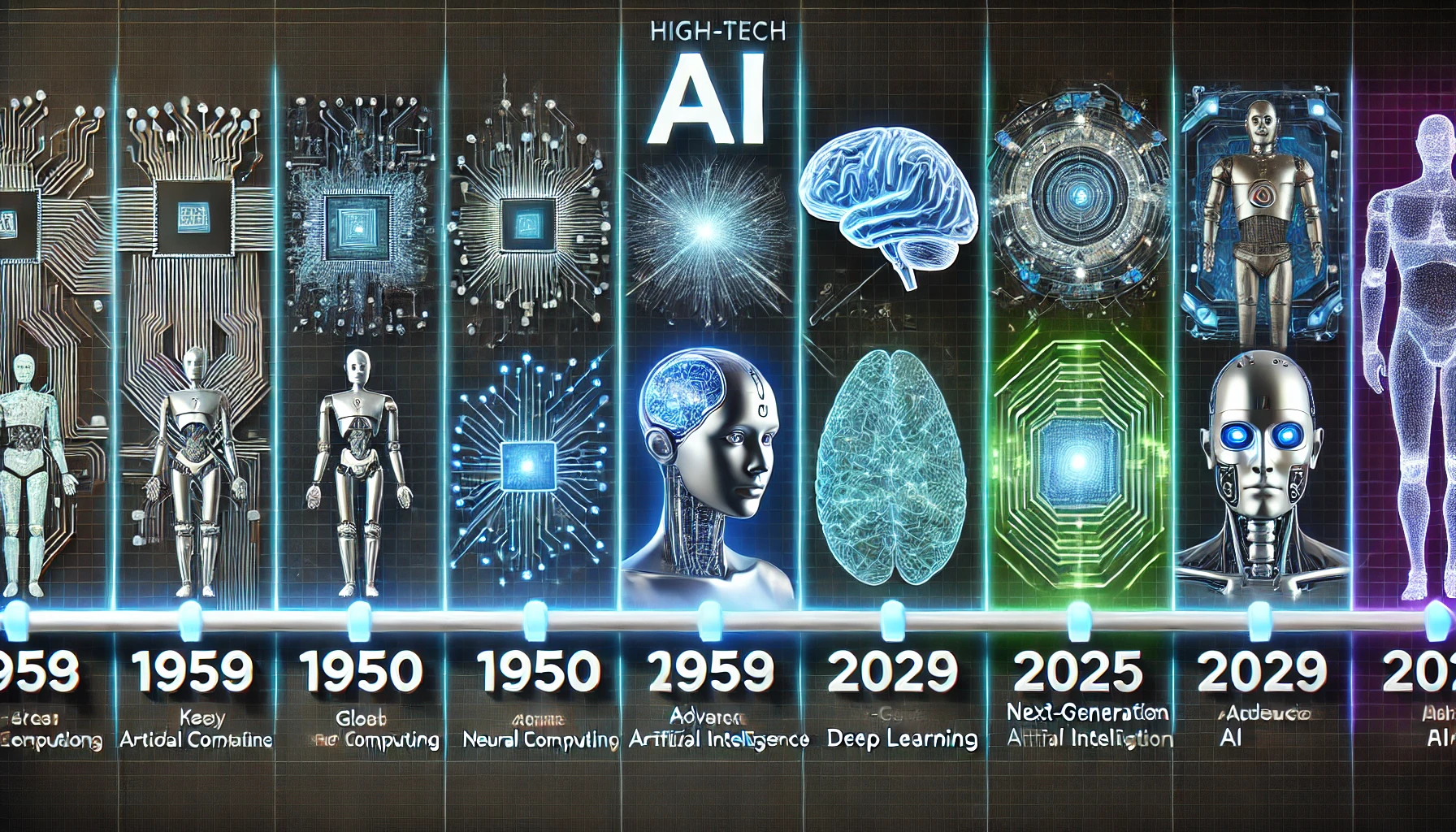
la chronologie met en évidence les étapes clés de l’histoire de l’intelligence artificielle (IA)

AI timeline

This timeline highlights key milestones in the history of artificial intelligence (AI), tracing its evolution from its origins in the 1950s to groundbreaking advancements in machine learning, deep learning, and generative AI through 2025.

1950s - The birth of AI

  • 1950 – Alan Turing introduit le test de Turing dans son article Computing Machinery and Intelligence, posant la question : « Les machines peuvent-elles penser ?
  • 1956 - The term Artificial Intelligence is officially coined by John McCarthy at the Dartmouth Conference, marking the birth of AI as an academic field.
  • 1957 – Frank Rosenblatt développe le Perceptron, le premier modèle de réseau neuronal.

1960s - Early AI Experiments

  • 1966 – Joseph Weizenbaum crée ELIZA, l'un des premiers chatbots imitant les conversations humaines.
  • 1969 - Développement de Shakey the Robot, le premier robot mobile capable de raisonner sur ses actions.

1970s - First AI Winter

  • 1973 - The UK government withdraws AI funding after disappointing results, leading to the first AI winter (a period of reduced investment and slowed progress).

Années 1980 - L'essor des systèmes experts

  • 1980 - Développement de systèmes experts, comme XCON par Digital Equipment Corporation, qui aident à la prise de décision en s'appuyant sur des bases de connaissances prédéfinies.
  • 1986 - L'algorithme de rétropropagation est amélioré, permettant un entraînement plus efficace des réseaux neuronaux profonds.

1990s - AI Dominates Games

  • 1997 - IBM’s Deep Blue defeats world chess champion Garry Kasparov, marking a milestone in AI capabilities.

    Années 2000 - L'essor de l'apprentissage automatique

    • 2006 - Geoffrey Hinton popularizes deep learning, laying the foundation for modern AI breakthroughs.
    • 2011 – IBM Watson bat les champions humains dans le jeu télévisé Jeopardy !

      2010s - Breakthroughs in Deep Learning and Everyday AI

      • 2012 - The AlexNet deep learning model wins the ImageNet competition, revolutionizing AI-based image recognition.
      • 2014 - Google’s DeepMind introduces AlphaGo, an AI capable of mastering the complex board game Go, later defeating world champion Lee Sedol (2016).
      • 2017 – Google introduit les modèles Transformer, conduisant à des percées dans le domaine du NLP (traitement du langage naturel) et au développement de modèles comme GPT-3.
      • 2018 - OpenAI develops GPT-2, a powerful AI capable of generating human-like text

        2020s - The Rise of Generative AI and AI in Society

        • 2020 - OpenAI launches GPT-3, one of the most advanced language models at the time.
        • 2021 - DeepMind introduces AlphaFold, an AI capable of accurately predicting protein folding, a breakthrough in biotechnology.
        • 2022 – ChatGPT (basé sur GPT-3.5) est lancé, gagnant rapidement en popularité en raison de ses capacités conversationnelles semblables à celles des humains.
        • 2023 - OpenAI introduces GPT-4, with improved reasoning, creativity, and multimodal capabilities (processing both text and images).
        • 2024 - Rapid development of AI agents and multimodal AI, including applications that combine text, image, and speech processing.
        • 2025 - AI advancements included the release of DeepSeek-R1, the launch of the $500 billion Stargate Project, a U.S. executive order to boost AI leadership, and breakthroughs in AI hardware with ultra-small, energy-efficient chips.

        AI timeline 2020 - now

        This timeline highlights key AI advancements from 2020 to 2025, showcasing breakthroughs in language models, generative AI, scientific discoveries, and autonomous systems that are shaping the future of technology.

        2020

        • GPT-3 Release (June 2020) – OpenAI launches GPT-3, a powerful language model capable of generating human-like text.
        • AlphaFold Breakthrough (novembre 2020) – AlphaFold de DeepMind résout un problème de repliement des protéines vieux de 50 ans, révolutionnant la biologie.

        2021

        • DALL·E & CLIP (January 2021) – OpenAI introduces DALL·E, an AI that generates images from text, and CLIP, a vision-language model.
        • Google’s LaMDA (May 2021) – Google unveils LaMDA, an advanced conversational AI designed for natural dialogue.

        2022

        ChatGPT (November 2022) – OpenAI releases ChatGPT, a chatbot based on GPT-3.5, gaining global attention for its human-like responses.

        2023

        • GPT-4 Release (March 2023) – OpenAI launches GPT-4, a more powerful multimodal AI capable of processing text and images.
        • AI-powered drug discovery (2023) – AI models accelerate medical research, leading to breakthroughs in drug development.
        • Google DeepMind’s AlphaDev (2023) – AI optimizes computer algorithms, improving software efficiency.

        2024

        • AI Agents & Autonomy (2024) – Advanced AI agents capable of reasoning, decision-making, and multi-step problem-solving emerge.
        • DeepSeek-R1 (January 2024) – Chinese company DeepSeek releases a powerful open-source AI model, rivaling top AI systems.
        • Stargate AI Project (January 2024) – A $500 billion initiative from OpenAI, Oracle, and others to build AI infrastructure in the U.S.
        • AI-driven scientific discoveries (2024) – AI accelerates breakthroughs in quantum computing, material science, and medicine.

        2025

        • Ultra-Efficient AI Hardware (February 2025) – Researchers develop an AI chip smaller than a grain of salt, advancing quantum computing and medical imaging.
        • AI-powered cybersecurity (2025) – AI enhances cybersecurity, detecting and mitigating cyber threats in real time.
        • Generative AI Expansion (2025) – AI becomes more integrated into daily life, from personalized AI assistants to real-time AI-generated content.

        This period marks rapid AI progress, with advancemen