Zum Hauptinhalt springen

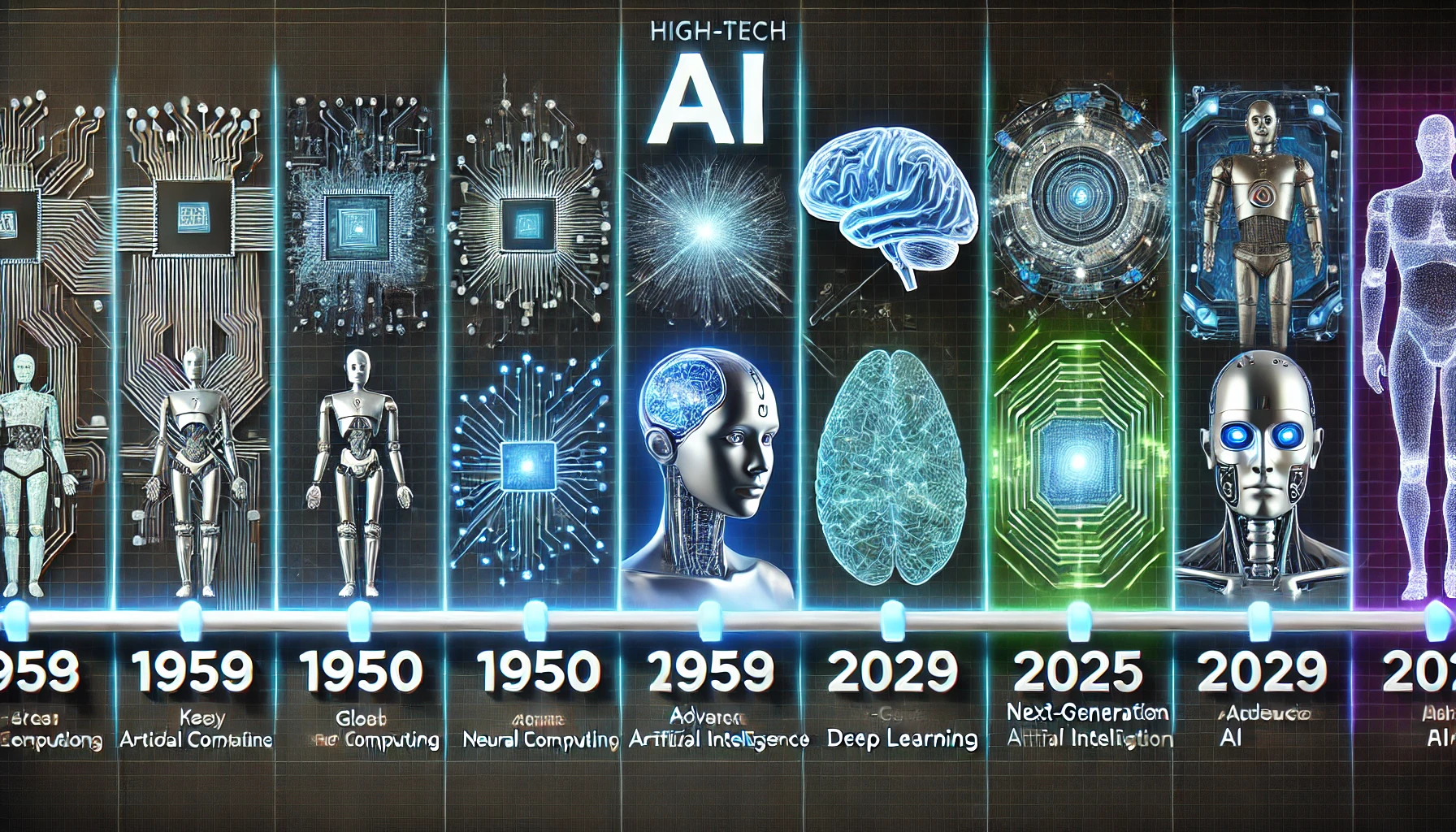
A timeline of key milestones: the evolution of AI

Explore the key milestones in the evolution of AI, from its early foundations in the 1950s to the latest breakthroughs in machine learning Und generative AI in 2025.

timeline highlights key milestones in the history of artificial intelligence (AI)

AI timeline

This timeline highlights key milestones in the history of artificial intelligence (AI), tracing its evolution from its origins in the 1950s to groundbreaking advancements in machine learning, Deep Learning, and generative AI through 2025.

1950s - Der birth of AI

  • 1950 - Alan Turing stellt vor Turing-Test in seinem Papier Computermaschinen und Intelligenz, und stellt die Frage: Können Maschinen denken?
  • 1956 - Der Begriff Künstliche Intelligenz is officially coined by John McCarthy at the Dartmouth Conference, marking the birth of AI as an academic field.
  • 1957 - Frank Rosenblatt entwickelt die Perzeptron, das erste neuronale Netzwerkmodell.

1960s - Early AI Experiments

  • 1966 - Joseph Weizenbaum kreiert ELIZA, einer der ersten Chatbots, der menschliche Konversationen nachahmt.
  • 1969 - Shakey der Roboter wurde entwickelt, der erste mobile Roboter, der in der Lage ist, über seine Handlungen nachzudenken.

1970s - First AI Winter

  • 1973 - Der UK government withdraws AI funding after disappointing results, leading to the first AI winter (eine Phase reduzierter Investitionen und verlangsamten Fortschritts).

1980er Jahre – Der Aufstieg der Expertensysteme

  • 1980 - Entwicklung von Expertensystemewie beispielsweise XCON von Digital Equipment Corporation, das bei der Entscheidungsfindung auf Basis vordefinierter Wissensdatenbanken hilft.
  • 1986 - Der Backpropagation-Algorithmus wurde verbessert, was ein effizienteres Training tiefer neuronaler Netze ermöglicht.

1990s - AI Dominates Games

  • 1997 - IBMs Tiefblau besiegt den Schachweltmeister Garry Kasparov, marking a milestone in AI capabilities.

    2000er Jahre – Der Aufstieg des maschinellen Lernens

    • 2006 - Geoffrey Hinton popularisiert Deep Learning, laying the foundation for modern AI breakthroughs.
    • 2011 - IBM Watson besiegt menschliche Champions in der Spielshow Gefahr!

      2010s - Breakthroughs in Deep Learning Und Everyday AI

      • 2012 - Der AlexNet Deep Learning model wins the ImageNet competition, revolutionizing AI-based image recognition.
      • 2014 - Googles DeepMind stellt vor AlphaGo, an AI capable of mastering the complex board game Gehen, besiegte später den Weltmeister Lee Sedol (2016).
      • 2017 - Google stellt vor Transformatormodelle, was zu Durchbrüchen in der NLP (Natural Language Processing) und zur Entwicklung von Modellen wie GPT-3 führte.
      • 2018 - OpenAI develops GPT-2, a powerful AI capable of generating human-like text

        2020s - Der Rise of Generative AI and AI in Society

        • 2020 - OpenAI launches GPT-3, eines der fortschrittlichsten Sprachmodelle seiner Zeit.
        • 2021 DeepMind stellt vor AlphaFold, an AI capable of accurately predicting protein folding, a breakthrough in biotechnology.
        • 2022 - ChatGPT (based on GPT-3.5) wird eingeführt und erfreut sich aufgrund seiner menschenähnlichen Konversationsfähigkeiten schnell wachsender Beliebtheit.
        • 2023 - OpenAI stellt vor GPT-4mit verbessertem Denkvermögen, Kreativität und multimodalen Fähigkeiten (Verarbeitung von Text und Bildern).
        • 2024 - Rasante Entwicklung von AI agents Und multimodal AIeinschließlich Anwendungen, die Text-, Bild- und Sprachverarbeitung kombinieren.
        • 2025 - AI advancements included the release of DeepSeek-R1, the launch of the $500 billion Stargate Project, a U.S. executive order to boost AI leadership, Und breakthroughs in AI hardware with ultra-small, energy-efficient chips.

        AI timeline 2020 - now

        This timeline highlights key AI advancements from 2020 to 2025, showcasing breakthroughs in language models, generative AI, scientific discoveries, Und autonomous systems that are shaping the future of technology.

        2020

        • GPT-3-Veröffentlichung (Juni 2020) – OpenAI launches GPT-3, ein leistungsstarkes Sprachmodell, das in der Lage ist, menschenähnliche Texte zu generieren.
        • AlphaFold-Durchbruch (November 2020) – DeepMind AlphaFold Löst ein 50 Jahre altes Problem der Proteinfaltung und revolutioniert damit die Biologie.

        2021

        • DALL·E & CLIP (January 2021) – OpenAI stellt vor DALL·E, an AI that generates images from text, Und CLIP, ein Bild-Sprach-Modell.
        • Googles LaMDA (Mai 2021) – Google enthüllt LaMDA, an advanced conversational AI designed for natural dialogue.

        2022

        ChatGPT (November 2022) – OpenAI releases ChatGPT, ein auf GPT-3.5 basierender Chatbot, der aufgrund seiner menschenähnlichen Antworten weltweit Aufmerksamkeit erregt.

        2023

        • GPT-4-Veröffentlichung (März 2023) – OpenAI launches GPT-4, a more powerful multimodal AI capable of processing text Und images.
        • AI-powered drug discovery (2023) – AI models accelerate medical research, leading Zu breakthroughs in drug development.
        • AlphaDev von Google DeepMind (2023) – AI optimizes computer algorithms, improving software efficiency.

        2024

        • AI Agents & Autonomy (2024) - Fortschrittlich AI agents Es entstehen Menschen, die zu logischem Denken, Entscheidungsfindung und mehrstufiger Problemlösung fähig sind.
        • DeepSeek-R1 (January 2024) – Chinese company DeepSeek releases a powerful open-source AI model, rivaling top AI systems.
        • Stargate AI Project (January 2024) – A $500 billion initiative from OpenAI, Oracle, Und others to build AI infrastructure in the U.S.
        • AI-driven scientific discoveries (2024) – AI accelerates breakthroughs in quantum computing, material science, Und medicine.

        2025

        • Ultra-Efficient AI Hardware (February 2025) – Researchers develop an AI chip smaller than a grain of salt, advancing quantum computing Und medical imaging.
        • AI-powered cybersecurity (2025) – AI enhances cybersecurity, detecting Und mitigating cyber threats in real time.
        • Generative AI Expansion (2025) – AI becomes more integrated into daily life, from personalized AI assistants Zu real-time AI-generated content.

        This period marks rapid AI progress, with advancemen